The short answer: you can train for a marathon on four runs a week: one harder run, two easy runs and one long run on the weekend. About 90% of the minutes are easy. In the biggest weeks the easy runs reach 90 minutes and the long run 2 hours 45 minutes. Below is a 16-week marathon plan built for a family schedule, a half marathon version, and what to do when a kid gets sick and the week falls apart.
Marathon and half marathon training for busy parents · endurancebydesign.com/marathon-training-busy-parents.html
This plan fits if:
It is not a fit if you are new to running (start with the half marathon plan) or if you are chasing a specific finish time and want a plan tuned to it. It builds your long run from 1 hr 45 min to 2 hr 45 min and peaks at 6 hr 40 min of running in a week.
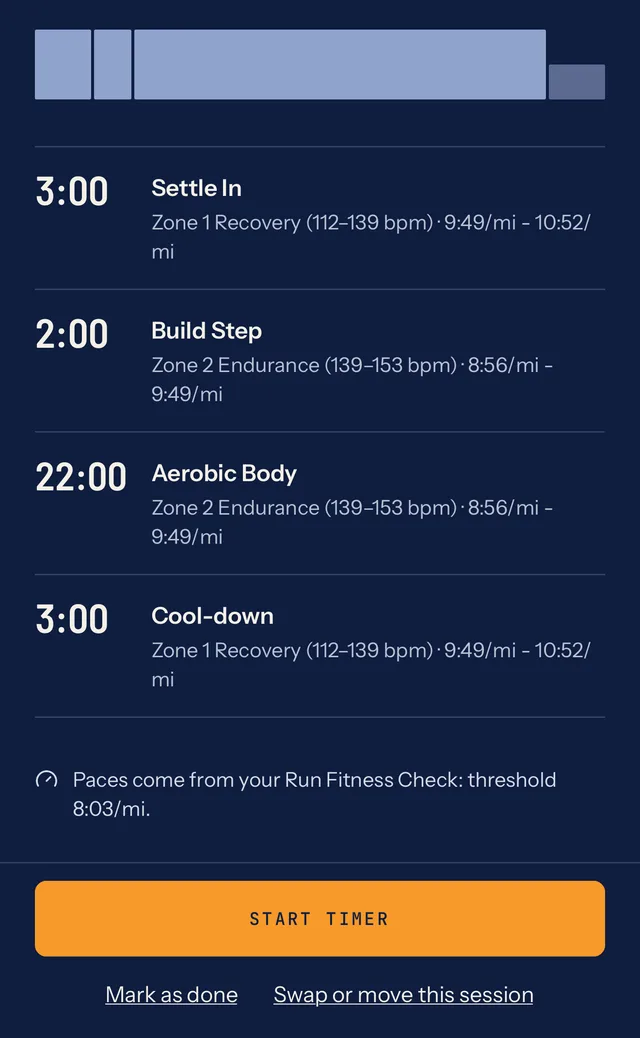
These 16 weeks are not a template written for the web. They are what the Endurance app's plan engine builds for a consistent runner on its seven to nine hour setting, with four training days and a Sunday long run.
Less time than that? On its four to six hour setting the app builds the same runner a smaller plan: weekday runs of 25 to 55 minutes, lighter weeks of only two or three runs, and a long run that reaches 2 hours 35 minutes.
Move days to fit your house. Two rules: do not put the Tuesday run and the long run on back-to-back days, and keep at least one full rest day.
| Day | Session | Time it takes |
|---|---|---|
| Monday | Rest | none |
| Tuesday | The one harder run (easy in weeks 1 and 2) | 40 to 55 min, shorter in the taper |
| Wednesday | Rest | none |
| Thursday | Easy run, plus 20 minutes of strength at home if you want it | 35 to 90 min |
| Friday | Rest | none |
| Saturday | Easy run | 40 to 90 min |
| Sunday | Long run | 1 hr 20 min to 2 hr 45 min |
Strength (optional, Thursday): 20 minutes of bodyweight work at home: split squats, step-ups, glute bridges, calf raises and planks. In the taper keep it to light core and mobility.
Run for the minutes shown. Distances are a guide at an easy 10:00 per mile (6:13 per km); if you run slower or faster, keep the minutes and let the distance change. Easy means you can speak in full sentences. Steady is comfortably firm. Tempo and strong are controlled and hard, a few words at a time. Rest on Monday, Wednesday and Friday.
| Week | Tue: the harder run | Thu: easy | Sat: easy | Sun: long run | Week total |
|---|---|---|---|---|---|
| Week 1 | 50 min easy, about 5 mi (8 km) | 50 min easy, about 5 mi (8 km) | 50 min easy, about 5 mi (8 km) | 105 min easy, about 10.5 mi (17 km) | 4 hr 15 min, about 25.5 mi (41 km) |
| Week 2 | 55 min easy, about 5.5 mi (9 km) | 55 min easy, about 5.5 mi (9 km) | 60 min easy, about 6 mi (9.5 km) | 110 min easy, about 11 mi (17.5 km) | 4 hr 40 min, about 28 mi (45 km) |
| Week 3 lighter | 50 min fitness check: about 15 min easy with a few strides, 20 min at your best steady effort, 15 min easy. About 5 mi (8 km) | 35 min easy, about 3.5 mi (5.5 km) | 40 min easy, about 4 mi (6.5 km) | 80 min easy, about 8 mi (13 km) | 3 hr 25 min, about 20.5 mi (33 km) |
| Week 4 | 50 min tempo run: 8 min easy, 25 min tempo, 17 min easy. About 5 mi (8 km) | 65 min easy, about 6.5 mi (10.5 km) | 70 min easy, about 7 mi (11.5 km) | 120 min easy, about 12 mi (19.5 km) | 5 hr 5 min, about 30.5 mi (49 km) |
| Week 5 | 50 min progression run: 17 min easy, 17 min steady, 16 min strong. About 5 mi (8 km) | 80 min easy, about 8 mi (13 km) | 85 min easy, about 8.5 mi (13.5 km) | 120 min long run: easy, with 17 min steady before an easy last 18 min. About 12 mi (19.5 km) | 5 hr 35 min, about 33.5 mi (54 km) |
| Week 6 lighter | 55 min cruise intervals: 8 min easy, 4 x 8 min tempo with 2 min easy jog between, 8 min easy. About 5.5 mi (9 km) | 45 min easy, about 4.5 mi (7 km) | 50 min easy, about 5 mi (8 km) | 90 min easy, about 9 mi (14.5 km) | 4 hr, about 24 mi (38.5 km) |
| Week 7 | 55 min fartlek: 8 min easy, 10 x 1 min fast with 1 min easy, about 25 min easy. About 5.5 mi (9 km) | 85 min easy, about 8.5 mi (13.5 km) | 85 min easy, about 8.5 mi (13.5 km) | 140 min easy, about 14 mi (22.5 km) | 6 hr 5 min, about 36.5 mi (58.5 km) |
| Week 8 | 40 min hilly tempo: 6 min easy, 28 min tempo over rolling ground, 6 min easy. About 4 mi (6.5 km) | 90 min easy, about 9 mi (14.5 km) | 90 min easy, about 9 mi (14.5 km) | 140 min long run: easy, with 2 x 20 min at marathon effort (5 min easy between) after the first hour. About 14 mi (22.5 km) | 6 hr, about 36 mi (58 km) |
| Week 9 lighter | 55 min tempo run: 8 min easy, 28 min tempo, 19 min easy. About 5.5 mi (9 km) | 50 min easy, about 5 mi (8 km) | 55 min easy, about 5.5 mi (9 km) | 105 min easy, about 10.5 mi (17 km) | 4 hr 25 min, about 26.5 mi (42.5 km) |
| Week 10 | 55 min threshold intervals: 8 min easy, 5 x 6 min strong with 2 min easy jog between, 8 min easy. About 5.5 mi (9 km) | 90 min easy, about 9 mi (14.5 km) | 90 min easy, about 9 mi (14.5 km) | 165 min easy, about 16.5 mi (26.5 km) | 6 hr 40 min, about 40 mi (64.5 km) |
| Week 11 lighter | 55 min progression run: 18 min easy, 18 min steady, 19 min strong. About 5.5 mi (9 km) | 60 min easy, about 6 mi (9.5 km) | 60 min easy, about 6 mi (9.5 km) | 115 min easy, about 11.5 mi (18.5 km) | 4 hr 50 min, about 29 mi (46.5 km) |
| Week 12 | 40 min race pace repeats: 6 min easy, 3 x 5 min strong with 3 min easy jog between, 13 min easy. About 4 mi (6.5 km) | 90 min easy, about 9 mi (14.5 km) | 90 min easy, about 9 mi (14.5 km) | 165 min long run: easy, with 3 x 20 min at marathon effort (5 min easy between) after the first hour. About 16.5 mi (26.5 km) | 6 hr 25 min, about 38.5 mi (62 km) |
| Week 13 taper | 40 min progression run: 26 min easy, 8 min steady, 6 min easy. About 4 mi (6.5 km) | 90 min easy, about 9 mi (14.5 km) | 90 min easy, about 9 mi (14.5 km) | 130 min easy, about 13 mi (21 km) | 5 hr 50 min, about 35 mi (56.5 km) |
| Week 14 taper | 30 min tempo run: 5 min easy, 15 min tempo, 10 min easy. About 3 mi (5 km) | 70 min easy, about 7 mi (11.5 km) | 70 min easy, about 7 mi (11.5 km) | 95 min easy, about 9.5 mi (15.5 km) | 4 hr 25 min, about 26.5 mi (42.5 km) |
| Week 15 taper | 20 min tempo run: 4 min easy, 13 min tempo, 3 min easy. About 2 mi (3 km) | 50 min easy, about 5 mi (8 km) | 50 min easy, about 5 mi (8 km) | 45 min easy, about 4.5 mi (7 km) | 2 hr 45 min, about 16.5 mi (26.5 km) |
| Week 16 race week | 15 min tempo run: 4 min easy, 8 min tempo, 3 min easy. About 1.5 mi (2.5 km) | 15 min easy, about 1.5 mi (2.5 km) | Friday: 25 min easy with the last 7 min building to steady. Saturday: 20 min very easy | Race: 26.2 mi (42.2 km) | 1 hr 15 min before the race |
Long run notes: long runs are easy unless the table says otherwise. In weeks 8 and 12 the long run includes blocks at marathon effort, the pace you plan to hold on race day. If you do not know it, put your week 3 fitness check or a recent race into the race time predictor, or run those blocks comfortably firm.
The taper: the last four weeks step down to about 85%, 65% and 40% of your biggest week, then a race week of four short runs.
Fuel the long runs: practice what you will drink and eat on race day from week 7 onward, when the long run passes two hours.
Training for 13.1 instead? Use our free 12-week half marathon training plan. It follows the same rules (runs set by time, two weeks up and one lighter week, a Sunday long run) with four runs a week and a long run that builds from 50 to 80 minutes, and every run is written out on the page. If your week only allows three runs, drop the Saturday easy run and keep the Tuesday run and the long run.
It will. A child gets a fever, a work trip lands, school is closed. These are the rules the app follows, written out so you can apply them on paper:
This is the part a paper plan cannot do for you. The Endurance app applies these rules on its own: an easy run you miss is absorbed, and a missed harder run or long run is moved into the next few days when there is room, never doubled up with another hard session.
Available on iPhone and Android. Free to download. The annual plan starts with a 7-day free trial.
I run, I race, and I am a dad of six sons. Every plan I tried assumed a perfect week. Mine never is. So Endurance starts from your race date and your real weekly schedule: the hours you actually have and the days you can actually run. It builds the plan backward from race day, tells you today's session from warm-up to cool-down, and realigns when life gets in the way. Read how it works in the science behind Endurance.
A fixed plan assumes 16 clean weeks and an easy pace of 10:00 a mile. Endurance builds the same kind of plan around your race, the hours you have each week, the days you can run and paces from your own fitness check, then eases a hard session after a heavy few days and asks whether to back off after a bad night's sleep. It is a training plan, not a GPS log.
Available on iPhone and Android. Free to download. The annual plan starts with a 7-day free trial.
Yes, if you already run regularly and can protect four runs a week, one of them long. Almost all of the running is easy. The long run is the session that needs the biggest block of time, so plan it first and fit everything else around it.
This plan uses four runs a week, every week. If your week only allows three, drop the Saturday run and keep the Tuesday run, the Thursday run and the long run. Do not add the lost minutes to another day.
Tuesday is the one harder run and takes 40 to 55 minutes. Thursday and Saturday are easy runs that start at 50 minutes and reach 90 minutes in the biggest weeks. If you have 30 minutes, run 30 minutes. A short run you finish beats a long run you skip.
Two hours 45 minutes, in weeks 10 and 12. At an easy 10:00 per mile that is about 16.5 miles (26.5 km). The plan sizes the long run by time instead of chasing 20 miles: past about two and a half to three hours, one run keeps adding recovery cost without adding much fitness. The marathon-effort blocks inside the long runs of weeks 8 and 12 do the race-specific work.
Do not try to catch up. If you miss an easy run, let it go. If you miss the long run, do it within the next two days if a day is open, otherwise let it go and carry on with the plan. If you lose a whole week, come back with one week at about half your usual running, all easy, then one week at about three quarters, then rejoin the plan.
Yes. The free 12-week half marathon plan on this site follows the same rules: runs set by time, two weeks of building then a lighter week, and a Sunday long run that peaks at 80 minutes.
Whenever you can protect it. Many parents run before the house wakes up, at lunch, or right after the kids are in bed. A fixed slot on the calendar works better than finding time each day. Pick the slots first, then build the week around them.
You enter your race, its date, how many hours a week you can train, which days are off and which day suits your long run. Endurance builds the plan backward from race day and prescribes each session. When a week falls apart, the plan realigns: an easy run you miss is absorbed, and a missed quality run or long run is moved into the next few days when there is room, never doubled up with another hard session.
Yes. Endurance is available on iPhone and Android. It is free to download, and the annual plan starts with a 7-day free trial.
For general fitness information only; not medical advice. Check with a physician before starting or significantly changing a training program. See our approach and sources.